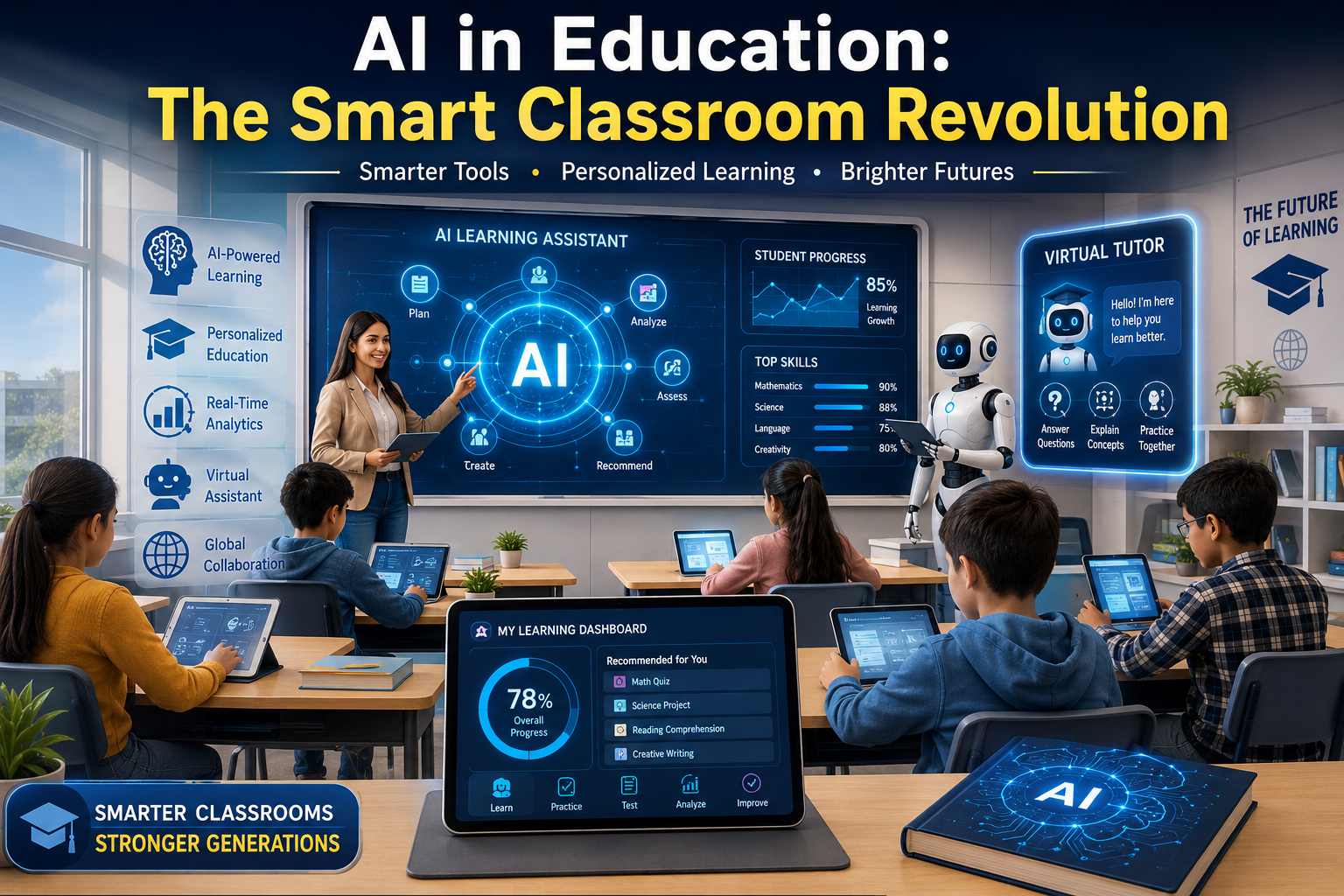
Think back to the “smart classrooms” of the early 2010s. Usually, that meant a school had scraped together enough budget to replace a traditional chalkboard with an interactive smartboard, or maybe they wheeled in a cart of iPads once a week. It was a step forward, sure, but it was ultimately just old wine in new digital bottles. The teaching methods stayed exactly the same; the screen just got bigger.
Today, a true smart classroom revolution is underway. Powered by multimodal Artificial Intelligence and data analytics, the modern classroom is transforming from a physical room where information is dictated into an active, interconnected ecosystem. It is adaptive, intuitive, and designed to understand the student just as much as the student understands the lesson.
1. What Actually Makes a Classroom “Smart”?
A smart classroom isn’t defined by how many devices are plugged into the wall; it’s defined by how fluidly those devices communicate to improve learning. In a modern AI-driven educational environment, several cutting-edge systems work behind the scenes:
-
Intelligent Tutoring Systems (ITS): Rather than standard educational software that gives a simple “correct” or “incorrect” binary response, AI tutors use natural dialogue-based interactions. They nudge students, ask Socratic questions, and dynamically adjust problem difficulty based on real-time performance.
-
Emotion-Sensing and Engagement Analytics: Some advanced digital learning interfaces utilize computer vision and natural language processing to detect when a student is zoning out, experiencing cognitive fatigue, or getting genuinely frustrated. The system can then flag the teacher or switch up the presentation style of the content to recapture their focus.
-
Automated Environmental Adaptation: Smart classrooms can automatically adjust lighting, acoustics, and air quality based on the time of day and the type of activity (e.g., dimming lights and focusing directional audio during a video presentation versus maximizing natural light during group collaboration).
2. Real-Time Data Feedback Loops
In a traditional setup, a teacher doesn’t truly know if a lesson clicked until they grade a stack of quizzes on Friday night—by which time the class has already moved on to the next topic.
AI-driven learning analytics completely eliminate this delay. As students work through digital modules, interactive simulations, or gamified quizzes, the system processes their inputs instantly.
[Student Interacts with AI Module]
               │
               ▼
[Real-Time Analytics Engine Compiles Performance Data]
               │
               ▼
┌──────────────────────────────┴──────────────────────────────┐
▼                                                             ▼
[Dashboard Flags Knowledge Gaps For Teacher]    [AI Adjusts Lesson Difficulty For Student]
This live feedback loop allows for targeted interventions. If the dashboard suddenly highlights that 65% of the class stumbled on the exact same step of a chemistry simulation, the teacher can immediately pause the independent work and address the core misconception on the board right then and there.
3. The Power of Immersive and Experiential Technology
Textbooks are inherently flat. They ask students to use their imagination to visualize a molecular bond, the scale of the solar system, or the architecture of ancient civilizations. Smart classrooms break down these spatial boundaries by pairing AI with Virtual Reality (VR) and Augmented Reality (AR).
Instead of just reading a chapter on ancient Rome, students can don VR headsets and take an immersive, AI-guided walking tour of the Colosseum. Medical and biology students can use AR overlays to isolate and interact with three-dimensional anatomical structures without touching a scalpel.
Because AI generates these environments and assets adaptively, the simulations can change based on the questions a student asks, creating a playground for hands-on, low-stakes experiential learning.
4. Balancing the “Illusion of Learning”
While the smart classroom opens up incredible opportunities, it also introduces a psychological trap that educators are working hard to navigate: the illusion of learning.
Recent research shows that when students rely too heavily on generalized, all-knowing AI chatbots to solve complex problems, their own cognitive retention and metacognitive skills actually take a hit. Because the AI makes arriving at the final output feel incredibly smooth, students often mistake the tool’s performance for their own understanding.
The fix? Purposefully designed pedagogical AI tools. Instead of giving out raw answers, these systems act as collaborative partners that prompt the student to think through intermediate steps, ensuring that the human brain does the heavy lifting.
The Human Core of the Smart Classroom
Ultimately, the smart classroom revolution isn’t about turning schools into sterile, automated computer labs. The ultimate goal of adding this layer of intelligence is to handle routine administrative tasks—like drafting baseline lesson structures, compiling spreadsheets, and basic grading—so that the actual physical environment becomes deeply human.
When technology takes care of the repetitive logistics, the classroom becomes a space dedicated to debate, mentorship, ethics, social-emotional development, and true collaborative human innovation.
🏷️ Optimized SEO Tags for This Article
Short-Tail Tags:
-
Smart Classroom
-
AI EdTech
-
Future Classrooms
-
AI Learning
-
VR Education
Medium-Tail & Long-Tail Tags:
-
AI in education smart classroom
-
Immersive VR learning analytics
-
Personalized AI classroom data
-
How AI is transforming schools
-
Adaptive learning technology trends
-
The illusion of learning in AI edtech
For a deeper look into how the role of an educator evolves when these technologies enter the picture, check out this discussion on Generative AI in Education: The Future of Teaching and Learning which explores how teachers are successfully shifting from rigid knowledge providers to adaptive learning facilitators.